Kazakhstan on Alert for Toy Protests

24 Feb

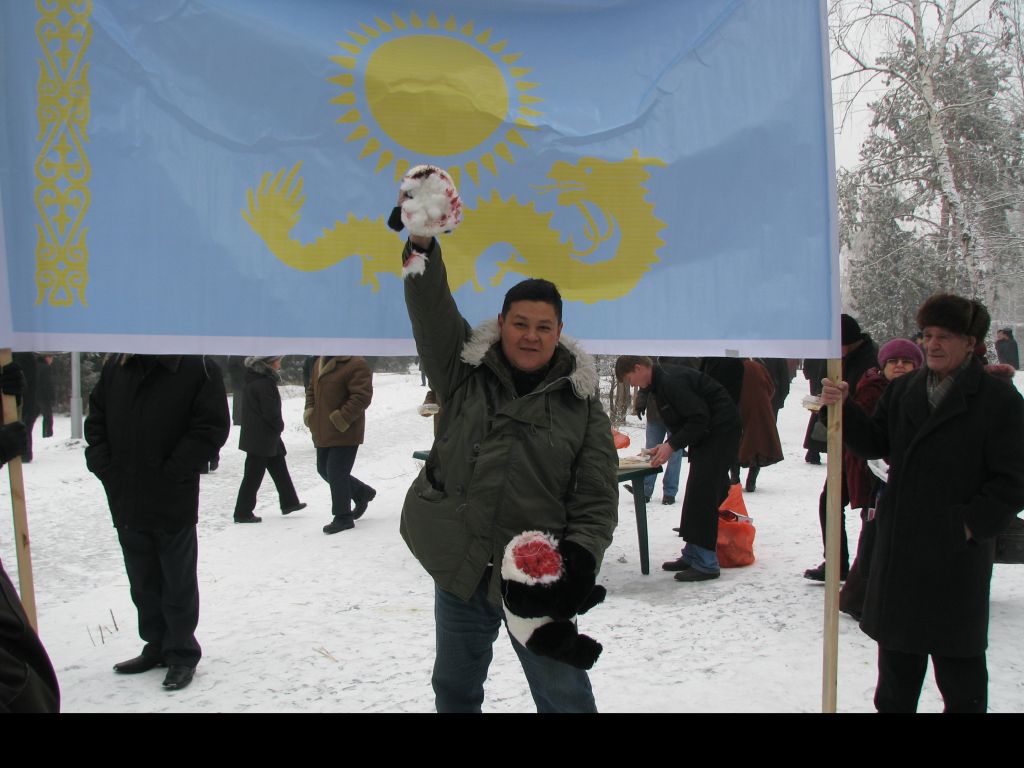
Image taken from Ivan Krupchik's blog http://ivan-krupchik.livejournal.com/11965.html

Reports are coming in from Kazakhstan on a crackdown on the sale of children’s toys ahead of the protests planned by opposition groups for Saturday, 25 February. Kazaxia tried to go to the Childrens’ World (Detsky Mir) store in downtown Almaty but found the doors firmly closed on a recent Thursday evening.

The authorities are worried that the toys might fall into the wrong hands after toy demos in Barnaul, Russia and Minsk, Belarus. Observers say that unsanctioned copycat demos, involving toys holding placards showing anti-government slogans, could break out in Kazakhstan unless steps are taken to restrict the sale of toys.

It is likely that Astana will follow Russia’s lead and ban toy rallies as toys are not considered to be citizens of Kazakhstan

“As you understand, toys, especially imported toys, are not only not citizens of Russia but they are not even people,” Andrei Lyapunov, a spokesman for Barnaul, told local media.

When Kazaxia called Detsky Mir to ask for comment on whether they had been told to ban toy sales to those over the age of 13, no-one answered the phone.

With Kazakhstan’s jails already overfilled with opposition figures, imprisoned for upholding their constitutional right to free assembly (via unsanctioned rallies), Astana will be keen not to see over-aged toy purchasers joining them.

Where’s Kazakhstan’s Pussy Riot?

7 Feb

With unsanctioned  gatherings set to become a feature of the political landscape in Kazakhstan, maybe it’s time for the beleaguered opposition to look to expand its horizons by tapping into some of the  methods being used in Russia.

Pussy Riot perform in their trademark day-glo balaclavas (http://pussy-riot.livejournal.com)

Kazaxia was particularly taken with Pussy Riot, the female Russian punk collective, which has played a series of impromptu gigs on Red Square and atop a detention centre and a trolley bus to demonstrate against the men of short stature tandem running the Kremlin.

How about a dombra-wielding collective comprised of feminists from Kazakhstan to shake up the grey suited men of both the authorities and the opposition?

In common with Kazkahstan, Russia also has strict controls on people exercising their constitutional right to free assembly – some witty types in Barnaul came up with a toy protest with toy figures holding mini placards. This has got the authorities wondering whether such a gathering can be classified as ‘unsanctioned’.

Kazakhstan: Artist Targeted in Crackdown

2 Feb

Kazakhstan’s crackdown on dissent, which has been unfolding since an ‘unsanctioned’ opposition rally in Almaty on 28 January, has seen performance artist Kanat Ibragimov hauled in to stand trial alongside well-known opposition figures such as Bolat Abilyov, Mukhtar Shakhanov and Gulzhan Yergaliyeva.

Kanat Ibragimov screams for democracy in Almaty on 28 January 2012

Kanat Ibragimov, unlike Bolat Abilov, escaped a prison sentence and was given a fine for daring to take to the podium and call for democracy. In the generally grey world of Kazakh politics, Kanat cuts a colourful figure with his history of protest actions. He posits himself on the side of art rather than politics, but his activities carry an edge that never fails to needle the authorities.

A panda meets an untimely end at the hands of Kanat Ibragimov, Almaty, January 2010

Kazaxia first came across Kanat at a rally in January 2010. The demonstration was protesting Chinese expansionism into Kazakhstan and Kanat’s response was to symbolically decapitate a toy panda. Other actions he has initiated include ‘A Fish Rots from the Head Down‘ in which he savages a fish with an axe on Almaty’s Republic Square. I wonder who the ‘head’ could refer to here?

While Astana can cope with any amount of shouting and barracking from the podium by the usual suspects, Kanat Ibragimov’s humour is an approach that the stilted grey men are ill-equipped to deal with. Fines and prison sentences will only spur this performance artist onto greater things.

Kazakhstan: Alsara Goes All Modest

25 Jan

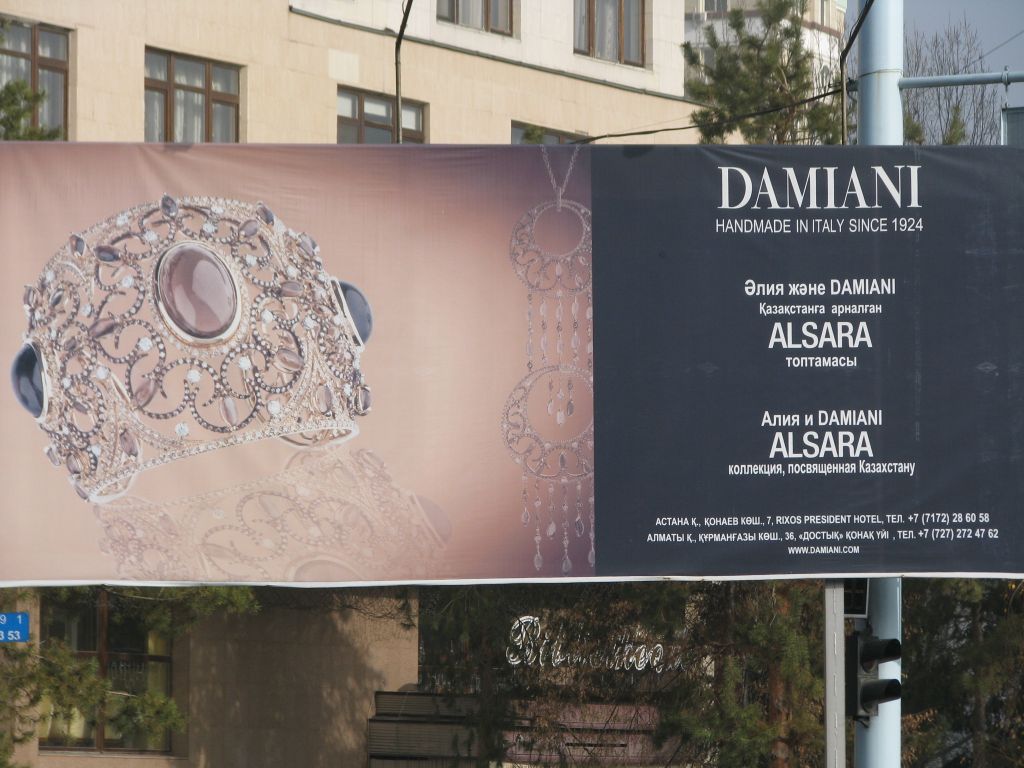
In a rare moment of modesty for a member of Kazakhstan’s ruling elite, Aliya Nazarbayeva’s top- end jewellery line, Alsara, is now being promoted in Almaty with an image of a piece from the collection rather than featuring Aliya as a model.

Alsara billboard in downtown Almaty without Aliya Nazarbayeva

Aliya Nazarbayeva teamed up with Italian jewellers Damiani in 2011 to produce Alsara, an exclusive collection of 30 diamond-studded pieces. The brand is a combination of the names of Aliya and her mother Sara and is aimed at Kazakhstan’s high-rollers with prices ranging from 15,000 to 70,000 euros. Here’s how the collection was being promoted.

Aliya Nazarbayeva promotes her Alsara jewellery brand

Kazakhstan: One Step Forward, Two Steps Back

20 Jan

Kazaxia has received the following contribution from Dr Boris B. Eltway of the Free University of Trans-Dniester Moldavian Republic on the recent election in Kazakhstan.

Kazakhstan has just been to the polls in what many observers are hailing as a major step forward on the long, rocky road to democracy. In the wake of Nur Otan’s crushing victory Astana is soaking up the plaudits for moving from a one-party parliament to a multi-party one with room being made in parliament for two other parties.

But hang on a minute, this is hardly Myanmar or some such place we’re discussing here. The one-party parliament only came about as no other party was able to exceed the seven percent threshold in 2007’s election. In 2004 Kazakhstan had a multi-party parliament with five political forces represented, including an earlier incarnation of Ak Zhol when it was a genuine opposition party, although it only took up its seat after a split in the party. So is this really a step forward?

Now the president’s party Nur Otan is being kept company by the latest model of Ak Zhol and The Communist People’s Party of Kazakhstan (not to be confused with the outlawed Communist Party of Kazakhstan). We have a very cosy little parliament with Ak Zhol a pro-business party, the split-off commies on the left and the center dominated by the party of power. Both the newcomers are pro-presidential – no statements were made in the election campaign to suggest otherwise.

In fact, very few issues were mentioned in the campaign anyway. The elephants in the corner – terrorism and industrial unrest were kept off the agenda and the massacre in Zhanaozen was deftly spun by the state-controlled media as being down to mysterious ‘third forces’ and oil company executives mishandling the situation.

That these two new arrivals are sham opposition parties is not under discussion in Astana – it is enough for the spin doctors and window dressers to merely be able to provide a semblance of a functioning democracy to the outside world.

Real power remains in the hands of one man – no matter how many parties are represented in parliament be they sham or genuine opposition, it remains a toothless, rubber-stamp body that carries out the orders of the executive without question.

The people of Kazakhstan deserve better from their leaders and from their nascent democracy.


Kazakhstan: Kleptys Denies Criticizing Elections

19 Jan

In the light of President Nazarbayev’s statement on 18 January that hired experts “who criticize our elections” will be barred from observing future polls in Kazakhstan, Kleptys Oil and Gas (KOG) has asked Kazaxia to publish this press release (for a small consideration).

Kleptys Oil and Gas (KOG) vehemently deny the allegation that its hired  observer, Lord Venal, was critical of the recent election in Kazakhstan.

It is not the policy of KOG to criticize elections in nations where it hopes to earn lucrative contracts. KOG is not a greedy company and will accept any slice of the pie, however miniscule it may be.

Lord Venal found the election to be totally free and fair along with those esteemed superpower democracies Russia and China, and the CIS observer mission.


Kazakhstan Election 2012: Venal’s View

17 Jan

Kazaxia has received the following contribution from Britain’s Lord Venal, who was recently in Kazakhstan to observe the parliamentary elections.

I’ve just returned to Venal Towers after another successful observation trip to Kazakhstan (kindly subsidised by Kleptys Oil and Gas (KOG)) and I’d like to share my positive feelings that the election has left me with.

First off I’d like to offer my hearty congratulations to Kazakhstan as it enters an exciting new phase of multi-party democracy. The election itself was very well-managed and went off without a hitch in this vast country that straddles both Europe and Asia.

It was an early start on the Sunday as I was ferried to the nearest polling station from my diggings at the splendid Rixos Hotel. Polling was sluggish in the morning session, but that came as no surprise to me as Sundays are always slow to get off the ground in the Venal household. By the time my minder from KOG suggested a spot of lunch at 12.30 turnout was a somewhat low 6.9%.

After a splendid lunch – hospitality is something that Kazakhstan excels at – I was feeling a bit woozy so I retired to my suite for a quick power snooze. By the time I got back to the polling station at 18.30 there had been a surge in voter activity and the turnout stood at an impressive 79.1%.

The last 90 minutes of voting passed by quickly as we cracked open a few bottles of bubbly to celebrate a good day’s work. Then it was off to the KOG post-election party at a secret location where representatives of Kazakhstan’s high and mighty were schmoozed until the early hours.

When one has been observing elections as long as I have, one sometimes thinks that one has seen it all, but this election threw up a few surprises even for me. As I mentioned in my earlier report from the Presidential election last April, Kazakhstan has a splendid tradition of giving presents to senior citizens and first-time voters – take note Britain!

Some other innovations that could well prove popular in Britain included ‘carousel voting’ where the voters are taken by mini bus to different polling stations and ‘family voting‘ where a representative votes for all the family members.

My only regret is that the next elections in Kazakhstan will not be until 2016. But with KOG’s new contacts made at the post-election bash, I’m sure I will be visiting these shores again in the not too distant future.

(Editor’s note: Lord Venal is a contributor to this blog and his views are not necessarily those of Kazaxia) 

Kazakhstan Goes to the Polls

11 Jan

Lord Venal has interrupted his winter break to share his thoughts on Kazakhstan’s upcoming parliamentary elections with Kazaxia.

Kazakhstan prepares for the rush of voters

Kazakhstan’s big day is getting ever closer and I have decided to cut short my winter break in the Maldives and share my thoughts on the latest developments in the land of Abay. It’s been quiet in the Maldives this year anyway as the boisterous Kazakh contingent was conspicuous by its absence after allforeign travel for officials was banned in the light of the troubles in Zhanaozen.

I have been keeping a close eye on events in Kazakhstan. After the unrest in the west some observers suggested postponing the elections and it was even mooted to cancel the vote in Zhanaozen, which is still under lockdown, but the Leader wisely pooh-poohed this idea. It is important at this troubling time that the people get out to the polling booths and put their support behind Nur Otan and the other party that will be in parliament to maintain peace and stability in the country. The banning of troublemaker opposition candidates such as Bolat Abilov and Gulzhan Yergaliyeva can only be for the good of the country as a whole.

I found a copy of Jonathan Aitken‘s latest work Kazakhstan and Twenty Years of Independence: Surprises and Stereotypes After 20 Years of Independence in my Christmas stocking and have been dipping into it with relish. Recent events in Kazakhstan suggest that maybe Jeffrey Archer, that other disgraced former Tory MP who has done time in prison, would have been a better choice to pen something about the country with his prolific fiction writing skills. I hope Akorda was happy with the present I sent – a copy of Nelson Mandela’s Long Walk to Freedom, which has some interesting ideas for contemplation.

2012 will be an exciting year for Anglo-Kazakh co-operation, especially with Tony Blair advising Astana. Next time I speak in the house I will highlight some business opportunities I have uncovered for British firms. With at least 16 people killed and scores wounded in Zhanaozen on 16 December there would appear to be a gap in the market for some non-lethal riot control materials such as water cannon, rubber bullets and tear gas. Britain’s long experience in Northern Ireland has made it a world leader in the production of riot control gear and this golden opportunity to assist Kazakhstan should not be missed.

Season’s Greetings from Kazaxia

23 Dec

Kazakh New Year Decorations near the President's residence in Almaty, Kazakhstan

Nazarbayev’s Annus Horribilis

19 Dec

It was back in 1992 that the UK’s Queen Elizabeth II coined the phrase annus horribilis, or horrible year, to describe a year in which her family was mired in endless scandals. In the light of recent events in Kazakhkhstan will President Nursultan Nazarbayev look back on 2011 as his very own annus horribilis?

2011 was meant to be the year that Kazakhstan basked in 20 glorious years of independence, stability and prosperity following the break up of the Soviet Union. Instead it looks set to go down in history as the moment when the post-Nazarbayev era really began as a wave of Islamic-inspired terrorism swept the country and independence celebrations were marred by the deaths of 14 people in the west.

The year got off to a good start for President Nazarbayev with the residual effects of hosting the OSCE summit in December 2010 and Kazakhastan sweeping the board at the Asian Winter Games, which were held in Almaty and Astana, contributing to a feel-good mood.

In April the presidential elections saw the incumbent trounce his three opponents, taking 96.5% of the vote. Things were looking good with few clouds on the horizon.

Then May came, bringing with it two unrelated events that may well be judged the point when the Leader’s iron grip began to loosen. In Zhanaozen in the west of the country, energy sector workers went on strike over a wage dispute. Later in May a suicide bombing in Aktobe, also in western Kazakhstan, brought the spectre of Islamic-inspired terrorism to Kazakhstan for the first time.

Both these events were handled poorly by the authorities. The suicide bombing was initially dismissed as being related to a ‘Mafia Kingpin’. In subsequent months more bombings were carried out with the security forces frequently in the firing line, prompting officials to acknowledge in late August that Kazakhstan was facing a terrorism problem.

In October a group calling itself Jund al-Khilafah (Soldiers of the Caliphate) emerged, releasing a video online which threatened reprisals against Kazakhstan over a new law on religion.

Over in Zhanaozen the industrial dispute rumbled on with the striking workers eventually being dismissed. The strike got some high-profile attention when Sting pulled out of a concert in Astana, for the joint birthday celebration of the Leader and the capital, over workers’ rights.

After the workers were fired, the authorities considered the strike to be over but the strikers thought otherwise and continued to occupy the main square in Zhanaozen in peaceful protests before everything ended in violence on 16 December with 11 dead and 86 injured.

The failure of the authorities to deal adequately with these situations has highlighted flaws in the country’s leadership and serious problems at the heart of the political system in Kazakhstan, with power held tightly by a small coterie of people.

Astana seems increasingly out of touch with the prevailing mood in the country where disaffection is growing. It remains to be seen whether the main political parties will make any serious attempts to address these issues in the forthcoming election, but don’t hold your breath.

Kazakhstan has long prided itself on being a beacon of stability in this troubled region, but with cracks beginning to appear in this facade could we finally be witnessing the end of an era?