16 November 2017
Astana has been keeping a close eye on events in Zimbabwe with the Leader of the Nation set to become the world’s 4th longest serving leader if Robert Mugabe is forced out of office following Zimbabwe’s coup that was not a coup.
16 November 2017
Astana has been keeping a close eye on events in Zimbabwe with the Leader of the Nation set to become the world’s 4th longest serving leader if Robert Mugabe is forced out of office following Zimbabwe’s coup that was not a coup.
Qazahi’a’ is pleased to announce that after many minutes of public consultation, President Nazarbayev has decided in his wisdom that Qazaqstan’s Latin alphabet will look like this:

The idea behind the switch from Cyrillic to Latin for the Qazaq language was motivated by a desire to make modern technology more user-friendly for Qazaqs. The Cyrillic alphabet currently uses 42 characters, making it awkward to use on tech devices as it uses up all the keyboard including the space usually used for numbers.
The president’s solution is a slimmed-down 32 letter alphabet using ‘ to modify letters so, for instance, ‘ch’ (a sound imported from Russian) becomes ‘c” and ‘sh’ becomes ‘s”.
Here at Qazahi’a’ we’re not convinced that apostrophes are the way forward, but who cares about that – it’s all been decided, as usual, from the top down.
11 September 2017
With Astana’s EXPO 2017 done and dusted, kazaxia is having a look at some of the hits and misses at Kazakhstan’s window to the world, which was on the theme of Future Energy.

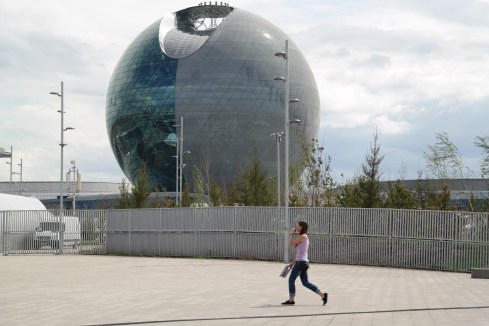
Crowds heading to Nur-Alem aka the Death Star
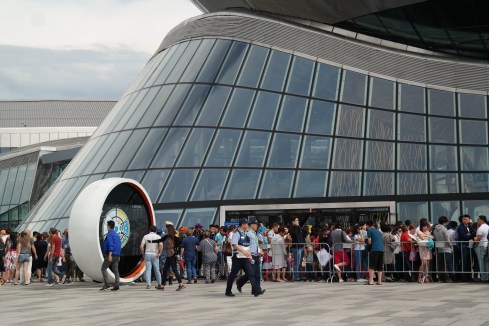
Top prize, of course, goes to Kazakhstan’s pavilion Nur-Alem, unflatteringly dubbed the Death Star by Foreign Policy. This was the biggest draw of the event with crowds queuing for hours to check out the eight floors of interactive displays on the green energy theme.

Queueing to enter Nur-Alem at EXPO 2017
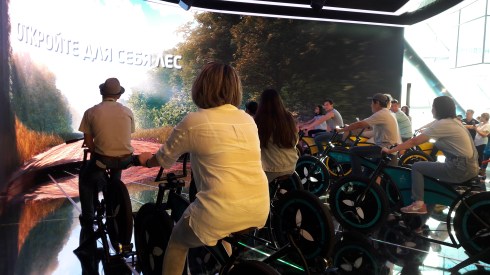
kazaxia’s particular favourite was the pedal-powered race which saw two teams face off to pedal as fast as they could and generate energy.

Pedal power face off in Nur-Alem
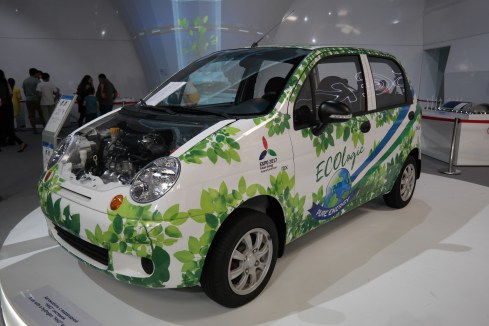
Special mention goes to Uzbekistan, which fully embraced the Future Energy concept with its Chevrolet (formerly Uz-Daewoo) Matiz adapted to run on a hydrogen-powered fuel cell.

Uzbekistan’s fuel-cell powered Matiz
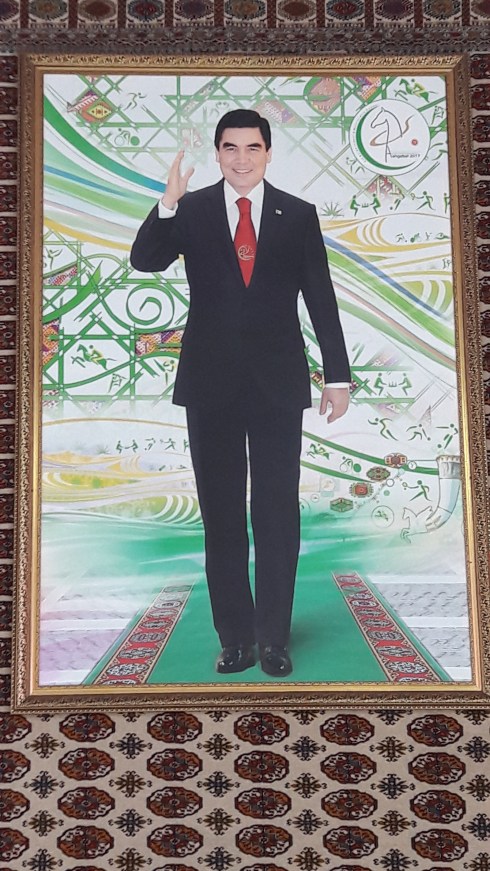
Turkmenistan seemed more intent on pushing President Gurbanguly Berdymukhammedov’s books and the upcoming Asian indoor martial arts fest in Ashgabat.

A warm welcome to Turkmenistan’s pavilion
Georgia’s pavilion predictably focused on wine production, ignoring the Future Energy message, but the kazaxia special prize was reserved for Russia with its novel take on the theme – it proposed using nuclear-powered ice breakers to crash through the ice cap to get at the fossil fuel deposits lurking in the depths of the Arctic Ocean.
The EXPO circus now moves on to the UAE leaving Astana with the task of transforming the site into a regional financial centre. Nur-Alem will remain as a museum for the general public to keep riffing on the green energy vibe.
We have received the following missive from an acquaintance of Lord Venal, who recently had cause to be in the Turkmen capital Ashgabat.
Somewhat disappointed by the closing of all nightclubs at an unearthly early hour, he was gratified to receive a personal invitation from President Gurbanguly Berdimuhamedov to drop by at one of his elegant palaces. “After a few drinks, His Excellency pulled out his guitar and treated me and the young ladies present to some of his favourite songs, all written by himself! Knowing I’m from distant Albion, we then settled down to watch the latest BBC production, Dictatorland, which His Excellency enjoyed, but only up to a point. Knowing that a friend from my (rather minor) public school works in the upper echelons of the BBC, he immediately dashed off a letter for me to pass on, which I reproduce below.”
To Director of BBC
London
England
Dear esteemed Sir!
I watched your fine show Dictatorland (thanks to excellent Hola!!) which show success in fellow region leaders in important task keeping order and maintaining popular support and stability in country Kazakhstan, Tajikistan, Belarus. You know these leaders follow me in my example how to keep good order on streets, even if in some way they act very primitive, like dictator of tinpot. We here in Turkmenistan famous not needing to shoot people on street like you showed in Kazakhstan, or beating people. We keep order by kindness and goodness of all police officers and lofty wisdom of president (myself).
So why then BBC not ask to come to Turkmenistan? We do not understand this incomprehensible decision. You only need to address yourself to me I arrange everything for you. See nice things, meet nice people. I let you interview me (but note you don’t ask questions, just stand up and write down everything I say in little notebook). You make good programme very popular around world and give glory to my country.
I look forward I hear from you with offer of coming to Turkmenistan.
Gurbanguly
(President)
Following his visit to Kazakhstan’s glitzy capital Astana last week, Uzbek president Shavkat Mirziyoyev, Sheva to his mates, has decided that he wants a bling-bling capital for himself and has set his sights on moving Uzbekistan’s capital from Tashkent to Uchkuduk, in the centre of the country.
Uchkuduk: set to change from this… … to this?
Uzbekistan’s rubber stamp parliament is set to give its approval to the move in a special session called for today. Moving the capital is being seen as a further consolidation of Sheva’s power – he has certainly been ringing the changes since his predecessor, Islam ‘Butch’ Karimov, died last year.
Uchkuduk, founded in 1958 as a Soviet ‘secret city,’ is in an ideal location for the capital as it is in the dead centre of Uzbekistan. It is at the heart of gold and uranium mining in the country and can be reached, with some difficulty, from all the main towns and cities.
President Mirziyoyev first heard about Uchkuduk at young pioneers’ camp in the 1980s via Yalla’s smash hit ‘Uchkuduk’. The president craves a Trump Tower as a centrepiece of the ambitious new capital and is keen on getting Mr Trump’s money men in the Kremlin on the case when Sheva and his boys visit Moscow later this year. Russian PM, Jimmy Bear, always on the lookout for a canny investment, is sure to be one of the first in line with a sackful of freshly laundered cash.
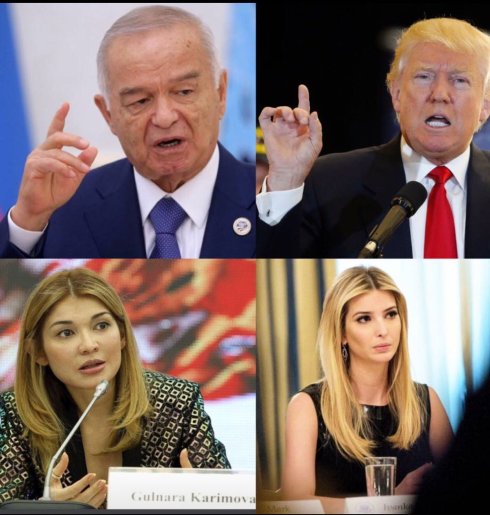
Ivanka Trump’s recent move into an office in the West Wing, despite her earlier protestations that she would not be taking a role in Daddy’s administration, has brought to mind another high-profile presidential daughter of recent times, Uzbekistan’s Gulnara Karimova.

Fathers and Daughters: Islam Karimov, Donald Trump, Gulnara Karimova and Ivanka Trump (photo borrowed from a tweet via @AmbKennedy_ret)
In American politics, there is little precedent for a president’s daughter taking on an advisory position in the White House. Maybe it is fitting to look at the rise and subsequent fate of the daughter of Uzbekistan’s late president Islam Karimov.
Gulnara Karimova, also known as GooGoosha, was once a high-flyer in Uzbekistan, dabbling in telecoms, show-business, high fashion, charity and construction – some even spoke of her as being next-in-line to the throne, but she suffered a spectacular fall from grace in March 2014 when she was placed under house arrest in Tashkent following a huge corruption scandal. Little has been heard of her since.
Keeping this in mind, Ivanka had better make sure she doesn’t get the wrong side of Daddy Trump, who is said to model himself on Karimov, the strongman president who ruled Uzbekistan for 25 years until his demise in September 2016.
Trump’s campaign slogan, “Make America Great Again,” is said to be modelled on Karimov’s “O’zbekiston kelajagi buyuk davlat” (Uzbekistan, the state with a great future).
These two cantankerous old guys both share a hatred of the free press, are prone to making bizarre off the cuff remarks, bear grudges indefinitely and are fiercely opposed to what they see as Islamic extremism.
Ivanka should be mindful of GooGoosha’s fate, or else she may find herself locked up in a shed in the White House grounds.
Kazakh artist, Saule Suleimenova, has found a novel way of dealing with some of the masses of plastic bags that litter Kazakhstan – by recycling them into artworks.

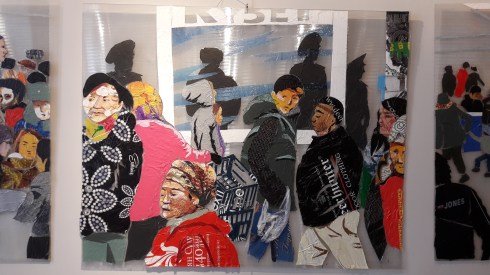
Saule Suleimenova’s ‘Civil Registration Office’ – note the shadowy police figures lurking in the background
Saule Suleimenova’s latest exhibition – called “… Somewhere in the Great Steppe”- features a series of paintings made entirely from discarded plastic items such as carrier bags and tablecloths – the style is known as cellophane painting. To see how the bags are recycled into paintings, check out this video.
The exhibition opens with images from the steppe across the four seasons and then travels into the city, taking in village life along the way. The collection is part of her ongoing projects I’m Kazakh and Aruakhs (Spirits of Ancestors), which combines archive images of Kazakhs against a backdrop of present-day scenes.
The themes in this exhibition are bang up to date with a triptych called ‘Civil Registration Office’ which depicts the chaos in registration centres at the start of this year when Kazakhstan introduced new laws to track the movements of its populace and assert its control over this formerly nomadic people.
The exhibition is open daily from 10.00-19.00 in Almaty’s Aurora Space, which is located by the Abay Opera and Ballet Theatre, on the corner of Baiseitov and Zhambyl Street, but you’ll have to hurry if you want to catch it as it closes on 23 March.
Presidents in Central Asia have been striving over the past 25 years to break through the mythical 100% of the popular vote threshold in elections. Once believed to be mathematically impossible, experts now think that with advances in technology the day may soon come when politicians can exceed 100% of the vote.

Turkmenistan’s President Gurbanguly Berdimuhamedov romped to victory once again with 97.69% of the vote
“As we have seen in recent elections in Central Asia, the incumbents are getting ever closer to the magical figure of 100%. Most recently, President Gurbanguly Berdimuhamedov picked up 97.69% of the vote in Turkmenistan’s elections, held on 12 February,” Lord Venal, a seasoned Central Asian election observer told kazaxia.
“And this was bettered in Kazakhstan in 2015 when President Nursultan Nazarbayev got 97.75%. So, yes, we could soon see the barrier being broken.”
Advances in fixing the vote has meant that scoring more than 100% should not be a problem in the future.
“Ballot stuffing, vote stealing, carousel voting – we’ve all seen these methods used over the years and these methods are becoming more sophisticated. Why not stuff in more votes than there are registered voters, it’s entirely possible,” Gary Kefali, a politics guru told kazaxia.
However, time may be against Nazarbayev – at 76 he may not have too many more chances at growing his vote beyond 98%. Berdimuhamedov, by contrast, is a relative youngster at only 59 and so he could have many more goes at reaching the Holy Grail of electoral success.
Turkmenistan and Kazakhstan’s incumbents offer the best hopes of breaching 100%. Relative newcomer, President Shavkat Mirziyoyev of Uzbekistan picked up 88.61% in 2016. Tajikistan’s President Emomali Rahmon grabbed only 83.92% of the vote in 2013. In Kyrgyzstan, President Almazbek Atambaev is a long way off as he got a measly 63.2% in 2011, and he won’t be running again anyway.
“President Nazarbayev should be up for election [in 2020?] before President Berdimuhamedov, and I foresee officials doing their utmost to make him the first leader ever to exceed 100% of the popular vote,” Venal concluded.
In its first move, the Association of Traditional Rulers has condemned the
late Cuban leader Fidel Castro for “failing to take seriously his
responsibilities as leader, in death as in life”.
The newly-formed Association unites Central Asia’s presidents – Gurbanguly
Berdymukhammedov of Turkmenistan, Nursultan Nazarbayev of Kazakhstan, Emomali
Rahmon of Tajikistan and Almazbek Atambayev of Kyrgyzstan, together with
candidate member Shavkat Mirziyoyev of Uzbekistan.

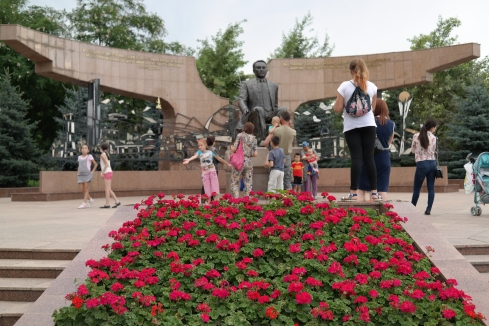
Kazakhstan’s President Nursultan Nazarbayev immortalised in an Almaty park
The Association pointed with regret to remarks at Fidel Castro’s funeral by
his brother and current leader Raul Castro that no monuments, institutions
or streets would be named after the late leader. Nor would statues and busts
be erected in his honour.
“The leader of the revolution strongly opposed any manifestation of cult of
personality,” said Raul Castro.
“The Association upholds the clear duty of all responsible leaders to accept
the burdens of office that history has thrust upon them,” a brief statement
from the Association declared. “Fidel Castro – in his dying wish – has
betrayed that trust.”
The Association insisted that a presidential personality “was not the
property of one lone individual, but belongs to the entire nation,
encapsulating, defining and leading that nation’s very essence, for all
eternity”. It termed any rejection of that lofty responsibility as
“selfishness”.
Central Asia’s leaders have graciously taken on themselves the burden of
having streets, towns or universities named after them, the Association
pointed out, and allowing statues of themselves or their ancestors to
inspire their populations in visible locations. They have also acceded to
popular requests to have portraits of themselves in schools, offices and
other locations.
The Association does however credit the late Cuban leader with adhering to
at least one of the standards of traditional rulers. “Fidel Castro did not
absolve himself of the responsibility to ensure that his close relatives –
and his mistresses – also selflessly took on the burdens of senior
government positions.”
Lord Venal is just back from his latest election monitoring mission in Uzbekistan. He was part of the unofficial Non-Aligned Observation Missions International (Naomi) group which visited the country as it prepared to anoint Shavkat Mirziyoyev as Islam Karimov’s rightful heir.
He’s kindly contributed this piece to kazaxia.
Ah, Uzbekistan! What a show it put on as the reins of power passed to Shavkat Mirziyoyev. I was part of a group of assorted Lords and bigwigs that were flown in to legitimise the transfer of power. As usual, the Uzbeks pulled out all the stops to make our stay a comfortable and memorable experience.

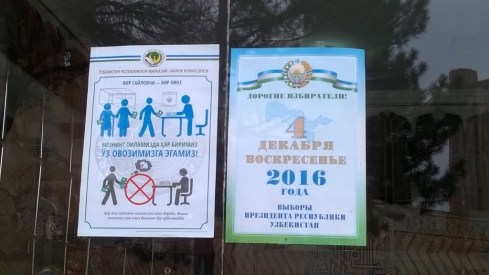
A polling station in Tashkent, Uzbekistan
We were kitted out with regulation observer rose-tinted spectacles and whizzed by train to Samarkand to pay our respects to two tyrants. The more recently deceased one was doing a roaring trade compared with the earlier model, Amir Timur aka Tamerlane, who in comparison was receiving a modest trickle of visitors.
The local flower sellers were doing good business – a possible opportunity for Britain’s gardeners to exploit in these post-Brexit times. Indeed, there could be many opportunities in Uzbekistan for Britain’s exporters as the new president looks like a character we can do business with.

Mr Miriziyoyev has good contacts with figures from the world of alt-business in Tashkent – this enthusiastic alt-businessman even shared a photo of himself on social media, squeezed into a tee-shirt proudly displaying the president’s image.

The election saw a campaign to eradicate the ancient local tradition of “one man, all the family’s votes” with the novel concept of “one person, one vote.” Unfortunately, I was feeling a bit under the weather on polling day, after having over-indulged in plov and local beverages the night before, so I am unable to confirm the success of this initiative as the polling station had closed by the time I got there.
As to the result, once again, in the year of the monkey, the pundits got it wrong – our very own Gary Kefali had predicted a win for Khatamjon Ketmonov. Instead, Uzbekistan will venture into its brave new world with Mr Mirziyoyev at the helm. Maybe next time Theresa May’s in town, she could pop in for a cup of tea and discuss some mutually-beneficial trade deals with the new boss.