Archive | Politics RSS feed for this section

Kazakhstan: Justice is Might

25 Feb

This slideshow requires JavaScript.


The authorities in Kazakhstan resorted to a show of brute force to keep a lid on protests in the commercial capital Almaty on 25 February. Hundreds of regular police in riot gear were augmented by special forces troops as an area of central Almaty was physically cordoned off by hundreds of officers in a bid to stop an opposition rally.

The organisers of the rally were rounded up before it took place, leaving other activists to lead the protest. Several arrests were made by snatch squads as the authorities came down hard on what it regards as an unsanctioned rally, despite Kazakhstan’s constitution safeguarding the right to free assembly.

This show of strength sent out a strong message that Astana is in no mood to compromise and that it will crush any dissent with an iron fist. Does anyone else sense an air of desperation in these actions, as the powers that be are increasingly backed into a corner with violence and intimidation as the last resort?

Kazakhstan on Alert for Toy Protests

24 Feb

Image taken from Ivan Krupchik's blog http://ivan-krupchik.livejournal.com/11965.html

Reports are coming in from Kazakhstan on a crackdown on the sale of children’s toys ahead of the protests planned by opposition groups for Saturday, 25 February. Kazaxia tried to go to the Childrens’ World (Detsky Mir) store in downtown Almaty but found the doors firmly closed on a recent Thursday evening.

The authorities are worried that the toys might fall into the wrong hands after toy demos in Barnaul, Russia and Minsk, Belarus. Observers say that unsanctioned copycat demos, involving toys holding placards showing anti-government slogans, could break out in Kazakhstan unless steps are taken to restrict the sale of toys.

It is likely that Astana will follow Russia’s lead and ban toy rallies as toys are not considered to be citizens of Kazakhstan

“As you understand, toys, especially imported toys, are not only not citizens of Russia but they are not even people,” Andrei Lyapunov, a spokesman for Barnaul, told local media.

When Kazaxia called Detsky Mir to ask for comment on whether they had been told to ban toy sales to those over the age of 13, no-one answered the phone.

With Kazakhstan’s jails already overfilled with opposition figures, imprisoned for upholding their constitutional right to free assembly (via unsanctioned rallies), Astana will be keen not to see over-aged toy purchasers joining them.

Where’s Kazakhstan’s Pussy Riot?

7 Feb

With unsanctioned  gatherings set to become a feature of the political landscape in Kazakhstan, maybe it’s time for the beleaguered opposition to look to expand its horizons by tapping into some of the  methods being used in Russia.

Pussy Riot perform in their trademark day-glo balaclavas (http://pussy-riot.livejournal.com)

Kazaxia was particularly taken with Pussy Riot, the female Russian punk collective, which has played a series of impromptu gigs on Red Square and atop a detention centre and a trolley bus to demonstrate against the men of short stature tandem running the Kremlin.

How about a dombra-wielding collective comprised of feminists from Kazakhstan to shake up the grey suited men of both the authorities and the opposition?

In common with Kazkahstan, Russia also has strict controls on people exercising their constitutional right to free assembly – some witty types in Barnaul came up with a toy protest with toy figures holding mini placards. This has got the authorities wondering whether such a gathering can be classified as ‘unsanctioned’.

Kazakhstan: Artist Targeted in Crackdown

2 Feb

Kazakhstan’s crackdown on dissent, which has been unfolding since an ‘unsanctioned’ opposition rally in Almaty on 28 January, has seen performance artist Kanat Ibragimov hauled in to stand trial alongside well-known opposition figures such as Bolat Abilyov, Mukhtar Shakhanov and Gulzhan Yergaliyeva.

Kanat Ibragimov screams for democracy in Almaty on 28 January 2012

Kanat Ibragimov, unlike Bolat Abilov, escaped a prison sentence and was given a fine for daring to take to the podium and call for democracy. In the generally grey world of Kazakh politics, Kanat cuts a colourful figure with his history of protest actions. He posits himself on the side of art rather than politics, but his activities carry an edge that never fails to needle the authorities.

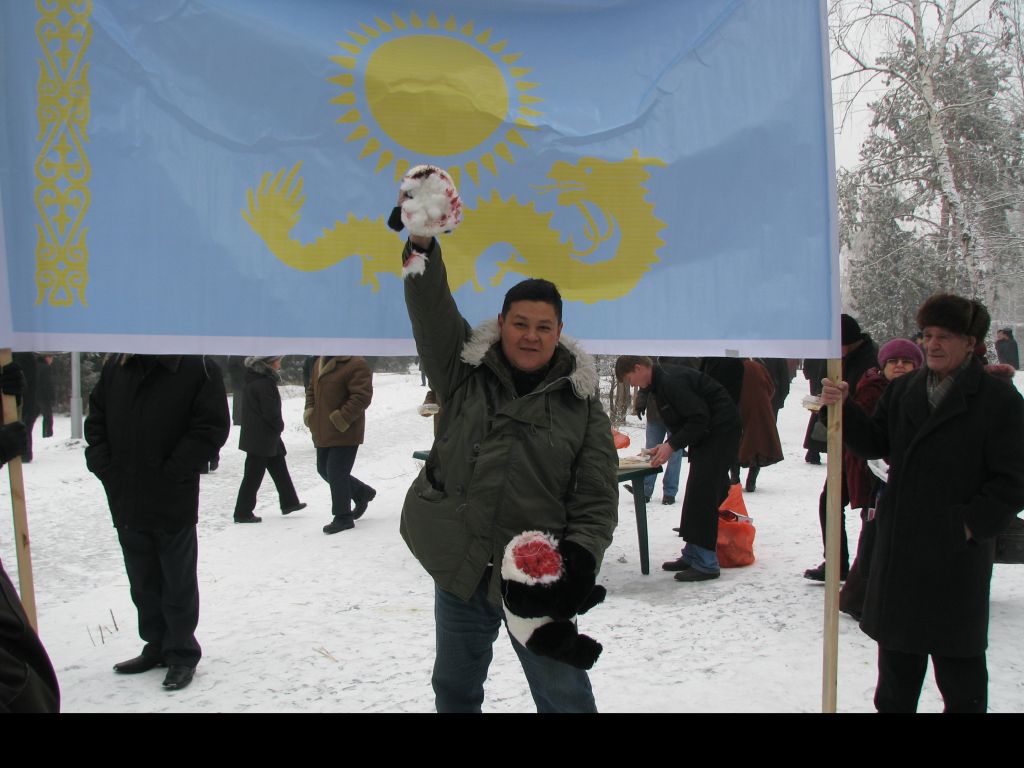
A panda meets an untimely end at the hands of Kanat Ibragimov, Almaty, January 2010

Kazaxia first came across Kanat at a rally in January 2010. The demonstration was protesting Chinese expansionism into Kazakhstan and Kanat’s response was to symbolically decapitate a toy panda. Other actions he has initiated include ‘A Fish Rots from the Head Down‘ in which he savages a fish with an axe on Almaty’s Republic Square. I wonder who the ‘head’ could refer to here?

While Astana can cope with any amount of shouting and barracking from the podium by the usual suspects, Kanat Ibragimov’s humour is an approach that the stilted grey men are ill-equipped to deal with. Fines and prison sentences will only spur this performance artist onto greater things.

Kazakhstan: One Step Forward, Two Steps Back

20 Jan

Kazaxia has received the following contribution from Dr Boris B. Eltway of the Free University of Trans-Dniester Moldavian Republic on the recent election in Kazakhstan.

Kazakhstan has just been to the polls in what many observers are hailing as a major step forward on the long, rocky road to democracy. In the wake of Nur Otan’s crushing victory Astana is soaking up the plaudits for moving from a one-party parliament to a multi-party one with room being made in parliament for two other parties.

But hang on a minute, this is hardly Myanmar or some such place we’re discussing here. The one-party parliament only came about as no other party was able to exceed the seven percent threshold in 2007’s election. In 2004 Kazakhstan had a multi-party parliament with five political forces represented, including an earlier incarnation of Ak Zhol when it was a genuine opposition party, although it only took up its seat after a split in the party. So is this really a step forward?

Now the president’s party Nur Otan is being kept company by the latest model of Ak Zhol and The Communist People’s Party of Kazakhstan (not to be confused with the outlawed Communist Party of Kazakhstan). We have a very cosy little parliament with Ak Zhol a pro-business party, the split-off commies on the left and the center dominated by the party of power. Both the newcomers are pro-presidential – no statements were made in the election campaign to suggest otherwise.

In fact, very few issues were mentioned in the campaign anyway. The elephants in the corner – terrorism and industrial unrest were kept off the agenda and the massacre in Zhanaozen was deftly spun by the state-controlled media as being down to mysterious ‘third forces’ and oil company executives mishandling the situation.

That these two new arrivals are sham opposition parties is not under discussion in Astana – it is enough for the spin doctors and window dressers to merely be able to provide a semblance of a functioning democracy to the outside world.

Real power remains in the hands of one man – no matter how many parties are represented in parliament be they sham or genuine opposition, it remains a toothless, rubber-stamp body that carries out the orders of the executive without question.

The people of Kazakhstan deserve better from their leaders and from their nascent democracy.


Kazakhstan Election 2012: Venal’s View

17 Jan

Kazaxia has received the following contribution from Britain’s Lord Venal, who was recently in Kazakhstan to observe the parliamentary elections.

I’ve just returned to Venal Towers after another successful observation trip to Kazakhstan (kindly subsidised by Kleptys Oil and Gas (KOG)) and I’d like to share my positive feelings that the election has left me with.

First off I’d like to offer my hearty congratulations to Kazakhstan as it enters an exciting new phase of multi-party democracy. The election itself was very well-managed and went off without a hitch in this vast country that straddles both Europe and Asia.

It was an early start on the Sunday as I was ferried to the nearest polling station from my diggings at the splendid Rixos Hotel. Polling was sluggish in the morning session, but that came as no surprise to me as Sundays are always slow to get off the ground in the Venal household. By the time my minder from KOG suggested a spot of lunch at 12.30 turnout was a somewhat low 6.9%.

After a splendid lunch – hospitality is something that Kazakhstan excels at – I was feeling a bit woozy so I retired to my suite for a quick power snooze. By the time I got back to the polling station at 18.30 there had been a surge in voter activity and the turnout stood at an impressive 79.1%.

The last 90 minutes of voting passed by quickly as we cracked open a few bottles of bubbly to celebrate a good day’s work. Then it was off to the KOG post-election party at a secret location where representatives of Kazakhstan’s high and mighty were schmoozed until the early hours.

When one has been observing elections as long as I have, one sometimes thinks that one has seen it all, but this election threw up a few surprises even for me. As I mentioned in my earlier report from the Presidential election last April, Kazakhstan has a splendid tradition of giving presents to senior citizens and first-time voters – take note Britain!

Some other innovations that could well prove popular in Britain included ‘carousel voting’ where the voters are taken by mini bus to different polling stations and ‘family voting‘ where a representative votes for all the family members.

My only regret is that the next elections in Kazakhstan will not be until 2016. But with KOG’s new contacts made at the post-election bash, I’m sure I will be visiting these shores again in the not too distant future.

(Editor’s note: Lord Venal is a contributor to this blog and his views are not necessarily those of Kazaxia) 

Kazakhstan Goes to the Polls

11 Jan

Lord Venal has interrupted his winter break to share his thoughts on Kazakhstan’s upcoming parliamentary elections with Kazaxia.

Kazakhstan prepares for the rush of voters

Kazakhstan’s big day is getting ever closer and I have decided to cut short my winter break in the Maldives and share my thoughts on the latest developments in the land of Abay. It’s been quiet in the Maldives this year anyway as the boisterous Kazakh contingent was conspicuous by its absence after allforeign travel for officials was banned in the light of the troubles in Zhanaozen.

I have been keeping a close eye on events in Kazakhstan. After the unrest in the west some observers suggested postponing the elections and it was even mooted to cancel the vote in Zhanaozen, which is still under lockdown, but the Leader wisely pooh-poohed this idea. It is important at this troubling time that the people get out to the polling booths and put their support behind Nur Otan and the other party that will be in parliament to maintain peace and stability in the country. The banning of troublemaker opposition candidates such as Bolat Abilov and Gulzhan Yergaliyeva can only be for the good of the country as a whole.

I found a copy of Jonathan Aitken‘s latest work Kazakhstan and Twenty Years of Independence: Surprises and Stereotypes After 20 Years of Independence in my Christmas stocking and have been dipping into it with relish. Recent events in Kazakhstan suggest that maybe Jeffrey Archer, that other disgraced former Tory MP who has done time in prison, would have been a better choice to pen something about the country with his prolific fiction writing skills. I hope Akorda was happy with the present I sent – a copy of Nelson Mandela’s Long Walk to Freedom, which has some interesting ideas for contemplation.

2012 will be an exciting year for Anglo-Kazakh co-operation, especially with Tony Blair advising Astana. Next time I speak in the house I will highlight some business opportunities I have uncovered for British firms. With at least 16 people killed and scores wounded in Zhanaozen on 16 December there would appear to be a gap in the market for some non-lethal riot control materials such as water cannon, rubber bullets and tear gas. Britain’s long experience in Northern Ireland has made it a world leader in the production of riot control gear and this golden opportunity to assist Kazakhstan should not be missed.

Kazakhstan after Nazarbayev: 4. The Long Shots

5 Aug

With rumours whirling around in the last few weeks about the health of Kazakhstan’s long-time president, the focus has once again turned to succession scenarios in Astana.

Kazaxia has decided to gaze into its crystal ball and look at some of the possible frontrunners should the Leader of the Nation decide to call it a day – here’s the fourth and final instalment:

In this part Kazaxia will look at some of the contenders on the fringes of the succession battle.

Dariga Nazarbayeva, the president’s eldest daughter, was at one time considered by many observers to be a shoo-in for the top job. But following the scandal which erupted around her former husband Rakhat Aliyev in 2007, her chances have faded and the president is believed to wonder where her true loyalties lie. It’s unlikely that any sort of door would be left open for Aliyev to return so it looks like she will have to make do with her opera singing.

Karim Masimov, the current Prime Minister, is a capable politician who is well-respected for his role in steering Kazakhstan through the global financial crisis. He’s tech-savvy, as can be seen by his slick website and blog and his presence on twitter. He’s a polyglot – fluent in Kazakh, Mandarin and English.

However, there’s one big question mark over whether he could become president – there’s a widespread, albeit unconfirmed, perception that he is Uyghur, although his father is reported to be Kazakh. Unfortunately, success in politics in Kazakhstan is not always based on merit – ethnic and clan affiliations also play a significant role – and in Kazakhstan only an ethnic Kazakh can realistically hope to become president.

Our last contender for consideration is Kairat Satybaldy, Nazarbayev’s nephew. He was brought up by the president’s family after his father died. Nazarbayev is thought to be close to Satybaldy, who’s in charge of youth policy in Nur Otan, the political party that has all the seats in Kazakhstan’s lower house of parliament. He has also held a top position in the KNB, Kazakhstan’s security service.

He could be the surprise candidate that Nazarbayev has up his sleeve to confound all the Astana watchers. Kazaxia wouldn’t put it past the wily old master politician to pull such a stunt.

So there you have it, Kazaxia’s lowdown on who might succeed President Nazarbayev. As long as the President remains healthy there’s no reason why he should give up his job, so we may have a long wait to see who will follow him. If you have any suggestions as to who the successor might be, please let us know.

Kazakhstan after Nazarbayev: 3. Changing of the Guard

3 Aug

With rumours whirling around in the last few weeks about the health of Kazakhstan’s long-time president, the focus has once again turned to succession scenarios in Astana.

Kazaxia has decided to gaze into its crystal ball and look at some of the possible frontrunners should the Leader of the Nation decide to call it a day – here’s the third instalment:

The Leader may feel its time to make sweeping changes in Kazakhstan with a changing of the guard by handing the reins of power to a younger figure to represent a break with the past. Two candidates spring to mind here – Imangali Tasmagambetov and Kairat Kelimbetov.

Imangali Tasmagambetov (image taken from http://www.astana.kz website)

Imangali Tasmagambetov, the current Mayor of Astana, is a former Prime Minister and Mayor of Almaty. He’s a popular figure, having served both Astana and Almaty well as Mayor. According to some reports, he may even have political principles – he reportedly resigned as PM in 2003 over a rigged vote of confidence in his government.

He cuts a more youthful and urbane figure than many of the grey men of Kazakh politics and has shown a willingness to embrace new technologies by holding Internet conferences and running an interactive page on his mayoral website. Born in 1956, he represents a younger generation in Kazakh politics and has the personality that would be able to push the country forward, if his track record in Almaty and Astnan is anything to go by.

A negative factor could be his perceived aloofness from the electorate. He’s a Kazakh speaker, but comes from a tradition of Kazakh intellectuals and does not come across as a man of the people. He lists as his hobby ‘the problems of history, ethnography and archaeology of Kazakhstan’.

Kazakh nationalists may not forgive him for labelling people protesting the destruction of their homes ‘social outsiders‘ in the 2006 property and land disputes in the Bakay and Shanyrak areas on the outskirts of Almaty. The protestors were in the main Kazakh speakers so were Tasmagambetov to become president, he should not expect as easy a ride as Nazarbayev has had at the hands of the ever more vocal nationalists.

Kairat Kelimbetov

Kairat Kelimbetov (image taken from http://www.weforum.org website)

Kairat Kelimbetov is a dark horse for the top job. Despite being only 42, he has held a number of key positions in Kazakhstan. He is currently the Minster of Economic Development and Trade and prior to that he was head of the state’s Sovereign Wealth Fund Samruk-Kaznya.

Kelimbetov studied at Georgetown University and is often wheeled out to represent Kazakhstan at big economic forums around the world. His strong background in economics and his fluency in English combined with his relative youthfulness makes him an attractive proposition for foreign governments and investors.

He would be the ideal candidate to make a clean break with the past as he is not seen to be too tainted by the Soviet era. However, his not entirely fluent Kazakh language skills may be a disadvantage – but he does have  the charisma to appeal to the electorate. Keep him in mind as a dark horse, though, biding his time while the other candidates fall to political in-fighting.


Kazakhstan after Nazarbayev: 2. The Old Guard

1 Aug

With rumours whirling around in the last few weeks about the health of Kazakhstan’s long-time president, the focus has once again turned to succession scenarios in Astana.

Kazaxia has decided to gaze into its crystal ball and look at some of the possible frontrunners should the Leader of the Nation decide to call it a day – here’s the second instalment:

2. The Old Guard

President Nazarbayev has some long-term lieutenants from the old days who can be trusted to carry out orders and get things done the way the president likes. Under consideration today are two members of the old guard: Nurtay Abykayev and Akhmetzhan Yesimov.

1229090100100100

Nurtay Abykayev (image taken from http://www.wok.kz website)

Abykayev has served Nazarbayev faithfully over the years and has been at various times Ambassador to the Russian Federation and the UK and chairman of the Senate of Kazakhstan. He has had a chequered political career but has always managed to bounce back into power.  He is seen as a safe pair of hands and is currently head of the KNB, the national security agency.

Like Nazarbayev he is from the south of Kazakhstan and is part of the President’s intricate balancing act between the clans from different areas of the country. He is an insider who knows all the ins and outs of Astana politics so would make a good candidate from that point of view.

A negative factor could be his age – he’ll be nearing 70 in 2016 when the next election is slated for. His age and background as a long-term insider may mean he would be resistant to the reforms and changes that some establishment circles feel Kazakhstan needs to make. He would represent a definite continuation of the status quo rather then a break with the past.

Akhmetzhan Yesimov (image taken from http://www.wok.kz website)

Yesimov is another veteran loyalist from the Soviet era. He has a background in farming having worked as the director of a collective farm. He worked his way up through the ranks and was Kazakhstan’s Minister of Agriculture for many years. He is currently Mayor of Almaty, a position he has held since 2008.

During his watch in Almaty he has failed to come to grips with the city’s chronic transport problems.  A possible scenario if he were to run the country could go like this – expect to see Kazakhstan turned into one huge gridlocked road with scant tree cover and a huge cloud of smog enveloping it.

He ticks all the political boxes having served as a Deputy Prime Minister, but again he represents more of a stop-gap throwback to the past rather than the dynamic figure Kazakhstan needs to push it forwards.