Archive | Nursultan Nazarbayev RSS feed for this section

Nazarbayev’s Annus Horribilis

19 Dec

It was back in 1992 that the UK’s Queen Elizabeth II coined the phrase annus horribilis, or horrible year, to describe a year in which her family was mired in endless scandals. In the light of recent events in Kazakhkhstan will President Nursultan Nazarbayev look back on 2011 as his very own annus horribilis?

2011 was meant to be the year that Kazakhstan basked in 20 glorious years of independence, stability and prosperity following the break up of the Soviet Union. Instead it looks set to go down in history as the moment when the post-Nazarbayev era really began as a wave of Islamic-inspired terrorism swept the country and independence celebrations were marred by the deaths of 14 people in the west.

The year got off to a good start for President Nazarbayev with the residual effects of hosting the OSCE summit in December 2010 and Kazakhastan sweeping the board at the Asian Winter Games, which were held in Almaty and Astana, contributing to a feel-good mood.

In April the presidential elections saw the incumbent trounce his three opponents, taking 96.5% of the vote. Things were looking good with few clouds on the horizon.

Then May came, bringing with it two unrelated events that may well be judged the point when the Leader’s iron grip began to loosen. In Zhanaozen in the west of the country, energy sector workers went on strike over a wage dispute. Later in May a suicide bombing in Aktobe, also in western Kazakhstan, brought the spectre of Islamic-inspired terrorism to Kazakhstan for the first time.

Both these events were handled poorly by the authorities. The suicide bombing was initially dismissed as being related to a ‘Mafia Kingpin’. In subsequent months more bombings were carried out with the security forces frequently in the firing line, prompting officials to acknowledge in late August that Kazakhstan was facing a terrorism problem.

In October a group calling itself Jund al-Khilafah (Soldiers of the Caliphate) emerged, releasing a video online which threatened reprisals against Kazakhstan over a new law on religion.

Over in Zhanaozen the industrial dispute rumbled on with the striking workers eventually being dismissed. The strike got some high-profile attention when Sting pulled out of a concert in Astana, for the joint birthday celebration of the Leader and the capital, over workers’ rights.

After the workers were fired, the authorities considered the strike to be over but the strikers thought otherwise and continued to occupy the main square in Zhanaozen in peaceful protests before everything ended in violence on 16 December with 11 dead and 86 injured.

The failure of the authorities to deal adequately with these situations has highlighted flaws in the country’s leadership and serious problems at the heart of the political system in Kazakhstan, with power held tightly by a small coterie of people.

Astana seems increasingly out of touch with the prevailing mood in the country where disaffection is growing. It remains to be seen whether the main political parties will make any serious attempts to address these issues in the forthcoming election, but don’t hold your breath.

Kazakhstan has long prided itself on being a beacon of stability in this troubled region, but with cracks beginning to appear in this facade could we finally be witnessing the end of an era?

Happy Birthday Kazakhstan?

16 Dec

Kazakhstan has been celebrating its 20th anniversary of independence today. In the capital Astana, President Nursultan Nazarbayev opened the country’s answer to the Arc de Triomphe in Paris – Infinity Land.

In the commercial capital, Almaty, celebrations were more muted. There were few people on Old Square when Kazaxia went to have a look.

A fairly deserted Old Square in Almaty on Independence day


Trouble was reported in the west of the country in the town of Zhanaozen, which has seen a long-running industrial dispute this past year. Reports of deaths ranging from 5 – 500 remain unconfirmed at the time of publication of this blog.

Vote for Nur Otan!


Meanwhile, the revellers who headed to Old Square in Almaty were greeted by the Leader beaming down from a billboard urging citizens to vote for his Nur Otan party in next January’s parliamentary elections.

Kazakhstan: The People’s Hero

29 Nov

Lord Venal would like to be one of the first to congratulate President Nursultan Nazarbayev on his being nominated for the prestigious title of People’s Hero so he sent Kazaxia this despatch

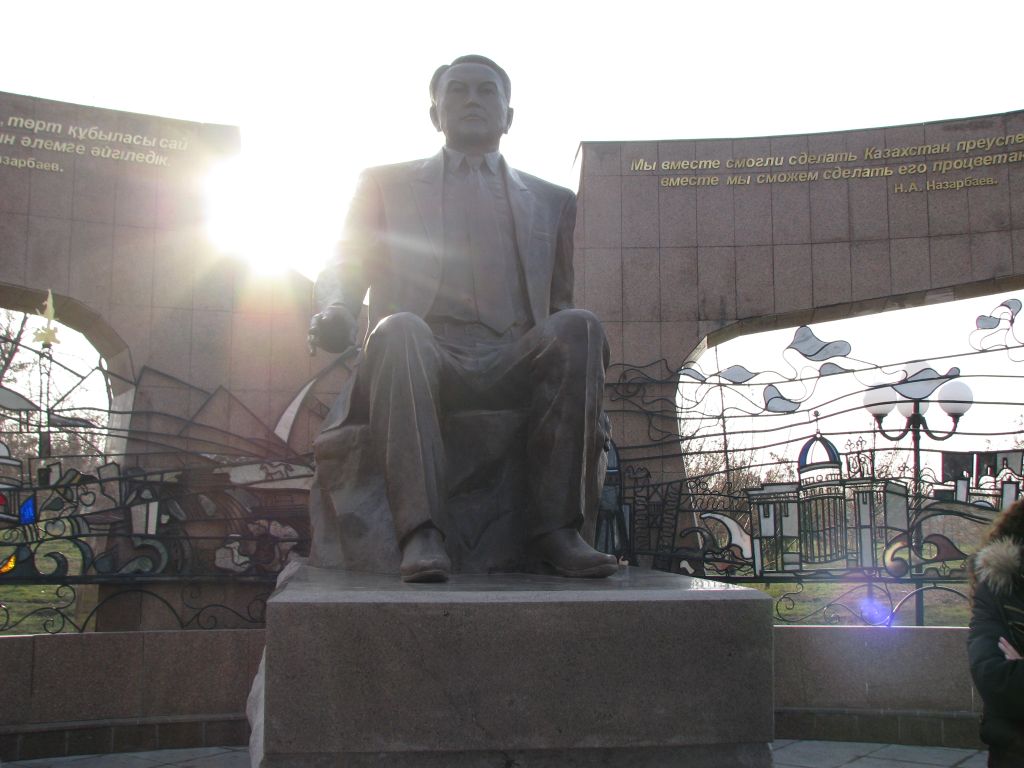
The People's Hero, The First President's Park, Almaty, Kazakhstan

I would like to take this opportunity to congratulate President Nazarbyev on his nomination for People’s Hero of Kazakhstan. It is not before time that Prime Minister Karim Masimov, who nominated the president for the award, has recognised President Nazarbyev for the great leader he has been to the people of Kazakhstan over the last two decades.

In just twenty short years Kazakhstan, under the guiding hand of its wise president, has gone from being an underdeveloped land of farmers and miners to the very edge of mature country status with its ongoing bid to join the Group of Grown Up Nations (GoGUN). Its recent decision to dispense with the services of the Peace Corps only highlighted its rapid development in recent years.

By nominating the president for this illustrious award the prime minister has proved once again what a staunch ally he has been to the great leader. I look forward to witnessing in person the great strides this country will take on the road of democratisation next January as it prepares to allow another party to join Nur Otan in parliament.

With the festive season almost upon us, my colleagues and I at the Centre for Reporting and Analysing Politics would like to raise a glass to President Nazarbayev. Let’s hope that this time next year we will be toasting the award of the long overdue Nobel Peace Prize for the Leader of the Nation.

Kazakhstan: Sau Bol Peace Corps

23 Nov

The Peace Corps’ 18-year presence in Kazakhstan was unceremoniously concluded last weekend with the sudden pull out of its remaining 171 volunteers from various projects around the country. Astana cited the reason for the abrupt departure of the volunteers as being “a rather logical step” in light of Kazakhstan’s “great progress in the political and socio-economic development over the 20 years of its independence.” A statement from the Peace Corps echoed this sentiment. 

Does this finally mean that Astana will no longer bang on about Kazakhstan being a ‘very young country’? Let’s hope so as it’s now coming up to its 20th anniversary of independence so it’s about time it took a more mature and responsible attitude.

Other reasons for the abrupt departure were mooted in this piece on Eurasianet including concerns about rape, sexual assault, possible terrorist attacks and alleged espionage.

There was also a lively debate on Registan invoving PC volunteers past and present.

Whatever the real reasons for the pull out, perhaps the Peace Corps had been moving away from its core mission in Kazakhstan – earlier this year Kazaxia was surprised to find Peace Corps volunteers working in the Nazarbayev Intellectual Schools, the country’s flagship secondary education project.

This school project, named, of course, after President Nursultan Nazarbayev, is well financed and even has a budget to employ English native speaker teachers in various subject areas. So why was it using the services of Peace Corps volunteers? Surely, their talents could have been better utilised in schools that weren’t all ready getting so much generous support?

Maybe the rapid development of Kazakhstan was such that there was really no longer a need for the Peace Corps in the general school system, although the new Nazarbayev Intellectual School network still needed the volunteers?

Kazakhstan: Monument to the Leader

21 Nov

Wedding parties and sightseers in Almaty have a new must-see on their itinerary with the recent opening of a monument to President Nursultan Nazarbayev in a park named in his honour, the First President’s Park.

This slideshow requires JavaScript.


The shrine has the Leader of the Nation seated atop a granite slab with eagle wings extending behind him. The wings symbolise independence – the free-spirited eagle also features on Kazakhstan’s flag – and feature scenes from Astana and Almaty.

Almaty is represented by the Kazakhstan Hotel and the TV Tower, while Astana is represented by the Pyramid (The Palace of Peace and Reconciliation), BayterekTower and Khan Shatyr. At the centre of the wings is an image of the sun god and some yurts.

Could this be the start of a mania for building monuments in Kazakhstan to the country’s long-serving president?

Kazakhstan after Nazarbayev: 4. The Long Shots

5 Aug

With rumours whirling around in the last few weeks about the health of Kazakhstan’s long-time president, the focus has once again turned to succession scenarios in Astana.

Kazaxia has decided to gaze into its crystal ball and look at some of the possible frontrunners should the Leader of the Nation decide to call it a day – here’s the fourth and final instalment:

In this part Kazaxia will look at some of the contenders on the fringes of the succession battle.

Dariga Nazarbayeva, the president’s eldest daughter, was at one time considered by many observers to be a shoo-in for the top job. But following the scandal which erupted around her former husband Rakhat Aliyev in 2007, her chances have faded and the president is believed to wonder where her true loyalties lie. It’s unlikely that any sort of door would be left open for Aliyev to return so it looks like she will have to make do with her opera singing.

Karim Masimov, the current Prime Minister, is a capable politician who is well-respected for his role in steering Kazakhstan through the global financial crisis. He’s tech-savvy, as can be seen by his slick website and blog and his presence on twitter. He’s a polyglot – fluent in Kazakh, Mandarin and English.

However, there’s one big question mark over whether he could become president – there’s a widespread, albeit unconfirmed, perception that he is Uyghur, although his father is reported to be Kazakh. Unfortunately, success in politics in Kazakhstan is not always based on merit – ethnic and clan affiliations also play a significant role – and in Kazakhstan only an ethnic Kazakh can realistically hope to become president.

Our last contender for consideration is Kairat Satybaldy, Nazarbayev’s nephew. He was brought up by the president’s family after his father died. Nazarbayev is thought to be close to Satybaldy, who’s in charge of youth policy in Nur Otan, the political party that has all the seats in Kazakhstan’s lower house of parliament. He has also held a top position in the KNB, Kazakhstan’s security service.

He could be the surprise candidate that Nazarbayev has up his sleeve to confound all the Astana watchers. Kazaxia wouldn’t put it past the wily old master politician to pull such a stunt.

So there you have it, Kazaxia’s lowdown on who might succeed President Nazarbayev. As long as the President remains healthy there’s no reason why he should give up his job, so we may have a long wait to see who will follow him. If you have any suggestions as to who the successor might be, please let us know.

Kazakhstan after Nazarbayev: 2. The Old Guard

1 Aug

With rumours whirling around in the last few weeks about the health of Kazakhstan’s long-time president, the focus has once again turned to succession scenarios in Astana.

Kazaxia has decided to gaze into its crystal ball and look at some of the possible frontrunners should the Leader of the Nation decide to call it a day – here’s the second instalment:

2. The Old Guard

President Nazarbayev has some long-term lieutenants from the old days who can be trusted to carry out orders and get things done the way the president likes. Under consideration today are two members of the old guard: Nurtay Abykayev and Akhmetzhan Yesimov.

1229090100100100

Nurtay Abykayev (image taken from http://www.wok.kz website)

Abykayev has served Nazarbayev faithfully over the years and has been at various times Ambassador to the Russian Federation and the UK and chairman of the Senate of Kazakhstan. He has had a chequered political career but has always managed to bounce back into power.  He is seen as a safe pair of hands and is currently head of the KNB, the national security agency.

Like Nazarbayev he is from the south of Kazakhstan and is part of the President’s intricate balancing act between the clans from different areas of the country. He is an insider who knows all the ins and outs of Astana politics so would make a good candidate from that point of view.

A negative factor could be his age – he’ll be nearing 70 in 2016 when the next election is slated for. His age and background as a long-term insider may mean he would be resistant to the reforms and changes that some establishment circles feel Kazakhstan needs to make. He would represent a definite continuation of the status quo rather then a break with the past.

Akhmetzhan Yesimov (image taken from http://www.wok.kz website)

Yesimov is another veteran loyalist from the Soviet era. He has a background in farming having worked as the director of a collective farm. He worked his way up through the ranks and was Kazakhstan’s Minister of Agriculture for many years. He is currently Mayor of Almaty, a position he has held since 2008.

During his watch in Almaty he has failed to come to grips with the city’s chronic transport problems.  A possible scenario if he were to run the country could go like this – expect to see Kazakhstan turned into one huge gridlocked road with scant tree cover and a huge cloud of smog enveloping it.

He ticks all the political boxes having served as a Deputy Prime Minister, but again he represents more of a stop-gap throwback to the past rather than the dynamic figure Kazakhstan needs to push it forwards.

Kazakhstan after Nazarbayev: 1. Keep it in the Family

29 Jul

Kazakhstan has long adhered to the principle of ‘one man, one vote’ but what happens if that one man – President Nursultan Nazarbayev – is unable to perform his duties? With rumours whirling around in the last week about the health of Kazakhstan’s long-time president, the focus has once again turned to succession scenarios in Astana.

Having been awarded the title of Leader of the Nation in 2010, the stage has been set for the incumbent to move aside but still control the reins of power. Could we see a situation where he takes everyone by surprise and does a ‘Boris Yeltsin’ and personally anoints his successor? At least he’ll be safe in the knowledge that the new president will not wield any real power while he’s still alive. Whatever he decides, he’s got the job until at least 2016, and with the history of longevity in his family who knows how long he’ll go on.

Kazaxia has decided to gaze into its crystal ball and look at some of the possible frontrunners should the Leader of the Nation decide to call it a day.  Kazaxia will be assessing their chances over the next few days – here’s the first instalment:

1. Keep it in the Family

Timur Kulibayev (Image taken from http://www.samruk-kazyna.kz website)

Current hot favourite is Timur Kulibayev – the ‘keep it in the family’ option. Kulibayev has risen high in the business world of Kazakhstan, possibly with the help of his powerful father-in-law – he’s married to Dinara, Nazarbayev’s middle daughter, and has three children with her. He comes across as a clean-cut family guy (see more on this below) who leads a sporty lifestyle with his passion for golf, skiing and football.

Kulibayev has carved a name for himself in Kazakhstan’s oil and gas industry and has held top positions in many of the state’s big players such as KazMunaiGas.  He is thought to be worth $1.3 billion on the Forbes rich list.

He is currently Chief Executive Officer of Kazakhstan’s powerful Sovereign Wealth Fund Samruk-Kazyna, which controls all state investments and holdings. Click here for a full biography of Kulibayev.

Remarks made recently by presidential advisor Yermukhamet Yertysbayev were interpreted as tipping Kulibayev as a suitable candidate to succeed Nazarbayev to the top job. Both Kulibayev and Yertysbayev were quick to downplay the report, but the fact remains that he would make a good candidate for the ruling family and allow it to keep pulling the strings.

The main obstacles to Kulibayev becoming president are his lack of political experience, his background is strictly business, and his Kazakh language skills – he rarely, if ever speaks in Kazakh in public so there are doubts about his fluency.  It is one thing to pass the language test given to prospective candidates for the presidency, but convincing the electorate is entirely another matter.

A candidate who struggles with the state language would not be popular with the nation’s increasingly influential Kazakh language lobby. This is an issue that is likely to come more to the fore after the current president moves on.

He also has some skeletons  in the cupboard that may not play well with the electorate. He had a long-term affair with Goga Ashkenazi and had a son with her, according to international media outlets. This involvement with Ashkenazi, a Kazakh socialite and businesswoman, doesn’t fit too well with the clean-cut family guy image. There have been accusations of money-laundering and corruption, but the Kazakh financial police cleared him of any wrongdoing.

All-in-all, though, Kulibayev still makes a good candidate. He has time to gain the necessary political skills and brush up his Kazakh. The lovechild may not be too much of a hindrance as this is not known about in Kazakskhstan. Kulibayev can still be regarded as the current favourite.

Sting Proves Astana Party Pooper

4 Jul

It looks like  Sting has taken Kazaxia’s advice, as the veteran British rocker pulled out of his planned concert in Astana, Kazakhstan amid concerns over human rights abuses in the country. He came under pressure from Amnesty International to cancel his show scheduled for 4 July because of the

repression and crackdown against oil workers, their union leaders, their legal representatives and of the human rights NGOs working with them

Sting got into trouble for playing a concert in Uzbekistan for Gulnara Karimova in 2009. Now he seems to have rediscovered his conscience and is once again positioning himself as the great human rights defender.

Earlier in the tour a date in Minsk, Belarus was cancelled, allegedly because of concerns over the economic situation in the country. Surely Lukashenko’s regime is much worse that the relatively benign one in Kazakhstan so it’s strange that Astana is taking the flak over its human rights’ record, whereas Belarus escaped criticism from Amnesty International.

The gig was to have been a central plank of the celebrations for the anniversary of the day Astana became Kazakhstan’s capital, 6 July, which also happens to be the birthday of Kazakh president Nursultan Nazarbayev.

The Leader of the Nation is likely to be not very amused at this latest turn of events and heads could well roll in Astana. His birthday treats have a tendency to fall flat – in 2008 the birthday boy looked on stony-faced as a somewhat tired and emotional looking  Whitney Houston stumbled around the stage.